Why Do People Really Become Addicted to Smoking?
If you've ever tried to quit smoking, you've probably asked yourself one question:
"Why is this so hard?"
Maybe you've tried quitting "cold turkey."
Maybe you've used nicotine patches, gum, vaping, or medication.
Maybe you've successfully quit for weeks, months, or even years, only to find yourself smoking again after a stressful event.
If that's happened to you, it doesn't mean you're weak.
And it doesn't mean you lack willpower.
The truth is, smoking addiction is far more complex than most people realize.
Understanding that complexity isn't discouraging. It's empowering. Because once you understand what you're really up against, you can begin changing it.
Smoking Is More Than a Nicotine Addiction
For decades, we've been told the same story:
Nicotine is addictive.
That's true.
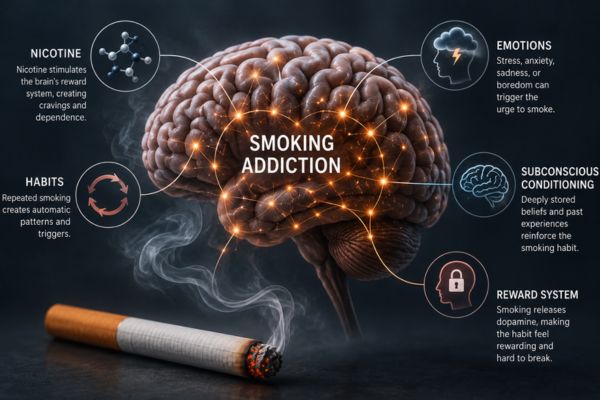
Nicotine stimulates the release of dopamine, a neurotransmitter involved in motivation, learning, and reward. Over time, your brain adapts to nicotine, leading to tolerance and withdrawal when it's no longer present.
But nicotine is only one piece of the puzzle.
If smoking were only about nicotine, then nicotine patches or gum would work perfectly for everyone.
They don't.
Many people continue craving cigarettes even while getting nicotine through another source.
Why?
Because what they're missing isn't just nicotine.
They're missing the ritual.
The emotional comfort.
The routine.
The familiarity.
The identity.
Your Brain Learns Patterns
Your brain is incredibly efficient.
One of its primary jobs is to identify patterns and automate them.
Think about all the things you no longer have to consciously think about.
Driving.
Brushing your teeth.
Typing your password.
Your brain has turned those repeated actions into habits.
Smoking works exactly the same way.
At first, lighting a cigarette is a conscious decision.
Eventually, it becomes automatic.
Coffee?
Light a cigarette.
Get in the car?
Light a cigarette.
Finish a meal?
Light a cigarette.
Feel stressed?
Light a cigarette.
Over time, your subconscious begins anticipating the cigarette before you're even aware you're thinking about it.
Smoking Changes More Than Chemistry
Every cigarette strengthens a network of associations.
Your brain begins connecting smoking with:
Relief
Comfort
Social connection
Celebration
Taking a break
Driving
Morning routines
Ending a meal
Managing difficult emotions
Eventually, the cigarette becomes woven into everyday life.
This is why someone can quit for months and suddenly crave a cigarette after smelling tobacco smoke, sitting on a familiar porch, or going through a stressful life event.
The brain remembers the pattern.
Cigarettes Are Designed to Keep You Smoking
Another piece many people don't realize is that commercial cigarettes are engineered products.
Manufacturers have spent decades refining the smoking experience.
Research has shown that cigarettes contain numerous additives that influence flavor, smoothness, and how smoke feels when it's inhaled.
Some compounds, including pyrazines, appear to enhance the sensory experience of smoking by reducing harshness and making cigarettes more appealing.
These sensory cues become part of what your brain learns to associate with smoking.
In other words, your brain isn't responding only to nicotine.
It's responding to an entire experience.
The Role of Stress
One of the strongest drivers of smoking isn't nicotine.
It's stress.
When life feels overwhelming, your nervous system naturally searches for familiarity.
For many smokers, cigarettes became the brain's shortcut to feeling better.
Not because the cigarette solved the stress...
But because smoking temporarily interrupted it.
You stepped away.
You breathed more slowly.
You focused on one thing.
Your nervous system experienced a brief shift.
Over time, your brain learned:
Stress = cigarette.
The longer that pattern repeats, the stronger it becomes.
The Identity of a Smoker
Perhaps the deepest layer of smoking addiction has nothing to do with chemistry at all.
It's identity.
If you've smoked for twenty or thirty years, smoking may no longer feel like something you do.
It feels like part of who you are.
You might catch yourself saying:
"I'm a smoker."
Those three words carry enormous weight.
Your subconscious is constantly trying to keep your behaviors consistent with your identity.
That's why, in my practice, I don't simply help people quit smoking.
I help them become non-smokers.
When your identity changes, your behaviors begin changing with it.
Why Hypnosis Can Be So Effective
If smoking involves brain chemistry, learned habits, emotional associations, routines, sensory cues, and identity...
It makes sense that lasting change requires more than willpower.
Hypnosis works by communicating directly with the subconscious patterns that keep the habit alive.
Instead of fighting cravings, we begin changing the programming beneath them.
We help disconnect cigarettes from stress.
We loosen old emotional associations.
We interrupt automatic habits.
We strengthen the identity of someone who simply doesn't smoke anymore.
That's a very different experience than spending every day trying not to light another cigarette.
You Are Not Broken
One of the most important things I want every smoker to understand is this:
You are not weak.
You are not lazy.
You are not failing because you lack discipline.
Your brain has simply learned an incredibly efficient pattern over time.
The wonderful thing about the brain is that it can also learn new patterns.
That's the foundation of neuroplasticity.
It's the foundation of hypnosis.
And it's the foundation of lasting change.
Ready to Become a Non-Smoker?
If you've spent years trying to quit smoking through willpower alone, maybe it's time for a different approach.
My Become a Non-Smoker Program combines personalized hypnosis, Neuro-Linguistic Programming (NLP), subconscious repatterning, and nervous system regulation to help you create lasting freedom from cigarettes.
Because my goal isn't simply to help you stop smoking.
It's to help you become someone who no longer wants to.
👉 Schedule your complimentary Quit Smoking Discovery Call today and let's talk about what becoming a non-smoker could look like for you.
Nikki's Perspective
One of the biggest shifts I see in clients happens when they stop asking, "What's wrong with me?" and start asking, "What has my brain learned?"
That question changes everything.
Instead of seeing themselves as someone who lacks willpower, they begin understanding that years of repetition have created deeply ingrained patterns in the brain, nervous system, and subconscious mind.
The beautiful thing is this: the same brain that learned those patterns can learn new ones.
That's why I love combining clinical hypnosis with nervous system regulation and Biofield Tuning. As the mind, body, and emotions begin moving into greater coherence, clients often discover that the urge to smoke no longer feels as powerful as it once did.
Real freedom doesn't come from fighting yourself.
It comes from understanding yourself, then gently teaching your mind and body a new way of being.
Disclaimer
The information provided in this article is intended for educational purposes only and should not be considered medical advice or a substitute for professional healthcare. Every individual and every health situation are unique. Always consult with your physician or another qualified healthcare professional regarding any medical condition or before making changes to your healthcare or smoking cessation plan. My goal is to share evidence-informed information while supporting your journey toward lasting health and well-being.


